How to raise money with cold emails only
 Nikita Blanc · · Updated
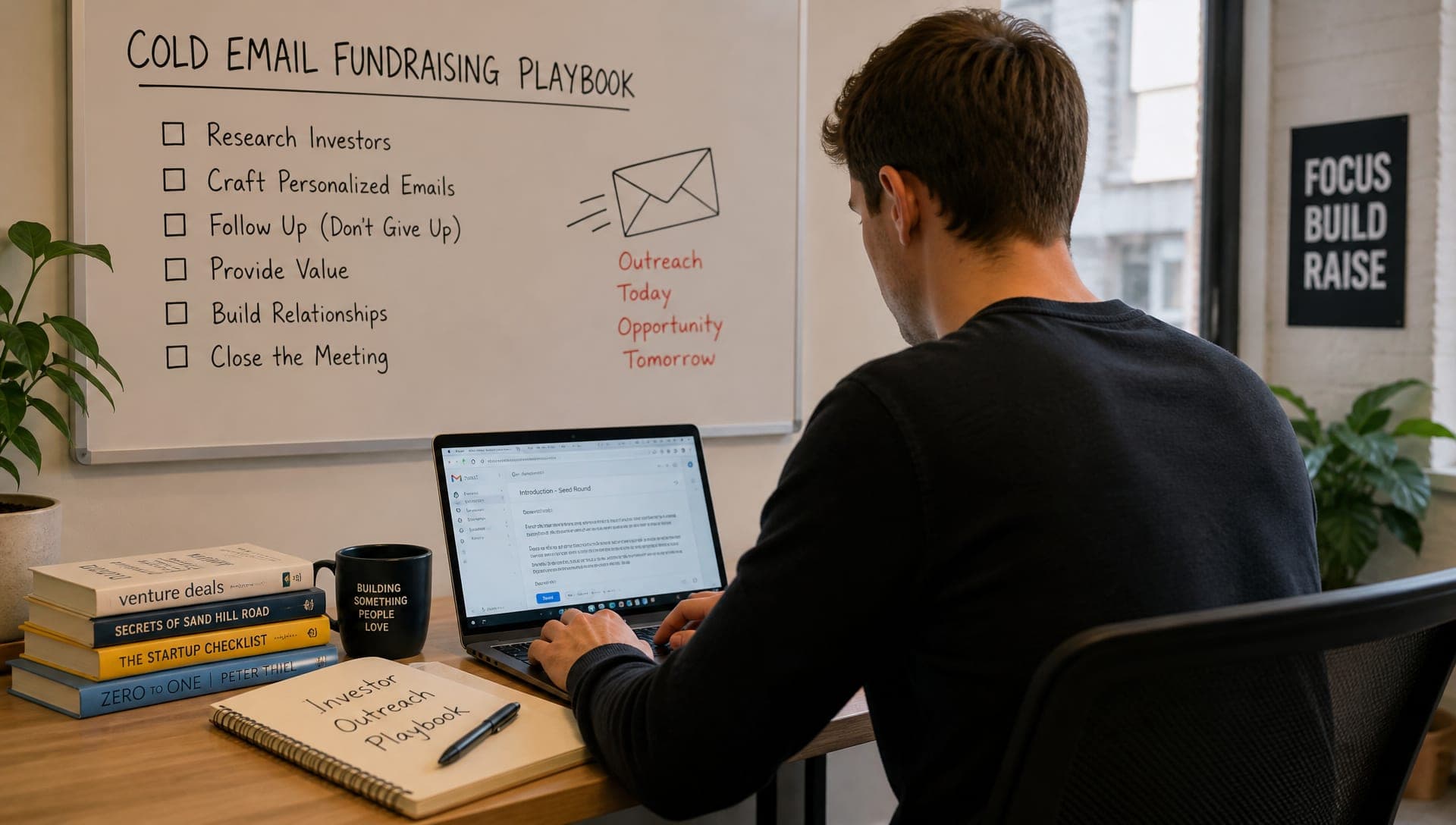
Key Takeaways
- Raising with cold emails only is possible but hard. Treat it like a sales pipeline, not a one-message hack.
- Targeting matters more than volume. Build a list of 100-300 relevant investors and sort it into tiers.
- A strong cold investor email is short and has seven parts: subject line, personal opener, one-sentence description, proof, fundraising context, investor relevance, and one clear call to action.
- Follow-ups drive many of the replies. Use a set schedule and share real updates.
- Test your message on Tier 2 and Tier 3 investors before you contact your best targets.
- Stay honest and compliant. Fake urgency and inflated numbers create legal and reputation risk, so speak with a startup attorney.
Warm intros help. But they are not the only way to get funded.
Many founders do not have a big investor network. Many do not live in a major startup hub. They still need capital.
If you are wondering how to raise money with cold emails only, the answer is not to send random pitch emails. It is to build a targeted outbound fundraising system.
This guide covers the full process, from building your investor list to closing your round. Cold email fundraising is possible. But it needs strong targeting, a short and clear pitch, proof, persistence, and a process you can repeat.
Can You Raise Money With Cold Emails Only? (Cold Email Fundraising Basics)
Yes, you can. But it is hard.
Think of cold email fundraising as a sales pipeline, not a one-message hack. Most emails get ignored. Some get a polite “not a fit.” A smaller group becomes calls. Only a few of those calls become checks.
Cold outreach works best when you have:
- A clear market
- A highly relevant investor
- A personal, specific email
- Early traction, a sharp insight, or a strong founder story
- A follow-up process you stick to
Why investors answer cold emails
- They are always looking for deal flow.
- They do not want to miss a great company.
- They often invest outside their own circle.
The limits
- Reply rates are low.
- Trust is harder to build without an intro.
- Your pitch has to be sharper.
- Both volume and quality matter.
The goal of the first email is not to close the round. It is to earn a reply or a short meeting.
When Cold Outreach Fundraising Makes Sense
Cold email works well in some situations.
- Pre-seed and seed rounds. Many early investors take new deals from anyone.
- Angel rounds. Angels often back founders they have never met.
- Rolling SAFE rounds. Investors can join at different times.
- Syndicate-led rounds. Syndicate leads look for new deals.
- Niche B2B startups. When the investor fit is clear, the email is easy to make relevant.
When it is less likely to work
- You have no clear business model.
- You cannot name your market.
- You have no traction and no founder-market fit.
- You email investors who do not invest in your stage, place, or sector.
Cold email works best with a strong fundraising story behind it. The email only opens the door. The story gets you through.
Build Your Fundraising Foundation Before Investor Outreach
Cold outreach makes weak positioning look worse. Fix your message before you send anything.
Get these ready first:
- A one-line company description
- A clear fundraising ask
- A short pitch deck
- A simple data room or diligence folder
- A short investor memo
- A current cap table
- An investor CRM or spreadsheet
- Short traction numbers
- Your round size and type: SAFE, convertible note, or priced round
Define the round
Be ready to explain:
- How much you are raising
- The type of deal
- Your valuation cap or target valuation, if you have one
- How you will use the money
- What milestones the money makes possible
- Whether you already have a lead or early commitments
Example: “We are raising $1.5 million on a post-money SAFE to expand the product team, convert pilot customers, and reach $1 million in annual recurring revenue.”
You do not need every term final. You do need to answer basic questions.
Know your story
Your story should cover:
- Problem
- Solution
- Market
- Traction
- Team
- Why now
- Why this investor
Find your best proof
Proof can be:
- Revenue or monthly growth
- Retention
- Active users or paid customers
- Pilot results
- Waitlist quality
- Partnerships or customer logos
- Product or technical milestones
- Founder experience
If you have little revenue, show things that lower the investor’s doubt. Customer interviews, signed pilots, repeat usage, and a sharp market insight all help.
Define the Right Investor Profile for Your Startup
The biggest mistake is emailing every investor. Most of them are not a fit.
Build an ideal investor profile. Include:
- Stage: angel, pre-seed, seed, or Series A
- Sector: SaaS, fintech, AI, healthcare, consumer, climate, and so on
- Geography: US-based, or active in US startups
- Check size: the amount they usually write
- Role: lead or follow-on
- Portfolio relevance: similar companies, but not direct competitors
- Recent activity: have they invested lately?
Match thesis to company
- A B2B SaaS startup should target investors with B2B SaaS companies in their portfolios.
- A healthcare startup should go after investors who understand healthcare rules and long sales cycles.
A portfolio shows an investor’s favorite stage, customer type, check size, and how hands-on they are.
Do not stop at the firm. Find the exact partner or investor who owns your category.
How to Build an Investor List That Gets Replies
A good investor list is the base of your whole campaign. Aim for roughly 100-300 relevant investors. The right number depends on your stage, round size, and other channels.
Where to find investors
- Crunchbase
- AngelList
- VC firm websites and portfolio pages
- PitchBook and Wellfound
- Founder communities
- Portfolio pages of similar startups
- Demo day and accelerator lists
- SEC Form D filings
- Podcasts, newsletters, and investor blogs
- Conference speaker lists
How to qualify each investor
Ask five questions:
- Do they invest at your stage?
- Have they invested recently?
- Do they invest in your sector?
- Do they write the right check size?
- Are they US-focused or active in the US?
Sort the list into tiers
- Tier 1: Great fit on stage, sector, check size, and thesis
- Tier 2: Good fit, with one or two weaker points
- Tier 3: Possible angels, new funds, or less certain matches
What to track
- Name, firm, and role
- Email and website
- Stage and sector focus
- Typical check size
- Relevant portfolio companies
- Personalization angle
- Date contacted and follow-up dates
- Status, notes, and next action
Do not waste your best targets early. Test your message on Tier 2 and Tier 3 first.
How to Email Investors Without Warm Intro
With no warm intro, your email has no borrowed trust. It must show relevance and credibility fast.
Investors often scan an email in seconds. Clear beats clever.
Your cold investor email should answer six questions:
- Who are you?
- What are you building?
- Who needs it?
- What proof says you can win?
- Why are you writing to this investor?
- What should happen next?
What every email needs
- A strong subject line
- A personal first line
- A clear company description
- Real traction or insight
- A specific reason for reaching out
- A simple call to action
What to leave out
- Long founder bios
- Huge attachments
- Generic claims like “revolutionary”
- Detailed financial projections
- Long paragraphs
- Too many links
Strong vs. weak personalization
Strong:
- “You invested in a vertical SaaS company serving independent clinics, and your firm focuses on healthcare workflow software.”
- “Your investment in [Company] suggests an interest in tools that help finance teams automate reconciliation.”
Weak:
- “I love your work.”
- “Your portfolio is impressive.”
- “I have been following your firm for a long time.”
Strong personalization gives the investor a reason to care. Weak personalization could be sent to anyone.
Anatomy of a Strong Cold Investor Email
A great email is short. It has seven parts.
- Subject line. Specific and easy to understand.
- Personal opener. Shows why this investor.
- One-sentence company description. Plain words, no jargon.
- Proof. One or two strong numbers or facts.
- Fundraising context. How much, and for what milestone.
- Investor relevance. Ties your company to their focus.
- Clear call to action. One simple ask.
Basic structure
“Hi [Name], saw your investment in [Company] and your focus on [thesis]. We’re building [Company], a [category] helping [customer] achieve [result]. We’ve reached [traction metric] and are raising [$X] to [milestone]. Would you be open to a quick conversation next week?”
Why each part matters
- The opener proves you did homework.
- The description lets them judge fit in one read.
- The proof builds trust.
- The round details help them see if the deal matches their check size.
- The call to action makes replying easy.
Ways to personalize
- Mention a portfolio company.
- Mention their investment thesis.
- Mention a podcast, article, or post they made.
- Mention their sector expertise.
Be specific, but keep it to one or two lines.
Cold Investor Email Templates You Can Adapt
Do not copy these word for word. Investors spot generic wording fast. Adapt each one to your company.
1. Short angel investor email
Use this for angels who know your industry.
Subject: [Company] - [specific traction or insight]
Hi [Name],
I am contacting you because of your experience with [industry, company, or background].
We are building [one-sentence description] for [customer]. Early signals include [proof point], [proof point], and [proof point].
We are raising [$ amount] from angels and early-stage investors to [milestone]. Would you be open to a short conversation, or should I send a one-page summary?
Best,
[Name]
2. Seed VC email
Use this when you have real numbers.
Subject: [Company] - [traction metric] in [market]
Hi [Name],
I am reaching out because [specific reason this investor is relevant].
[Company] helps [customer] solve [problem] by [solution]. We have reached [revenue, users, or customers] and are growing [metric] by [rate or period].
We are raising [$ amount] to [specific objectives]. Given your investments in [companies or category], would a short intro call be useful?
Best,
[Name]
3. Follow-up email
Use this 3-5 business days after the first email.
Subject: Re: [original subject]
Hi [Name],
Following up on the note below. Since my last email, we have [new customer, milestone, or update].
Would a 20-minute conversation be worthwhile? If this is outside your focus, a quick “not a fit” is also helpful.
Best,
[Name]
4. “No response” follow-up
Use this as a final nudge. Keep it very short.
Subject: Re: [original subject]
Hi [Name],
I know inboxes get busy. I will assume the timing is not right unless I hear otherwise.
If helpful, I can send a short deck. Either way, thank you for your time.
Best,
[Name]
5. Re-engagement email after a traction update
Use this when you hit a real milestone and someone has not replied or said “too early.”
Subject: [Company] update: [new milestone]
Hi [Name],
Since we last wrote, we have [new customers, revenue, launch, or partnership].
We are still raising [$ amount] and have [round progress, if true]. Would it make sense to talk now?
Best,
[Name]
6. Email to an investor who backed a similar company
Use this when the investor funded a nearby company, but not a competitor.
Subject: Building [product] for [customer category]
Hi [Name],
You invested in [relevant company] and have written about [relevant market], so I thought [Company] might fit your focus.
We are building [one-sentence description] for [target customer]. In the past [time period], we have [traction or milestone].
We are raising [$ amount] to [use of funds and milestone]. Would you be open to a 20-minute conversation next week?
Best,
[Name]
[Title], [Company]
[Website] | [LinkedIn]
Bonus: permission-to-send-deck email
Subject: May I send a short deck?
Hi [Name],
I am the founder of [Company], which helps [customer] solve [problem].
We have [traction or validation] and are raising [$ amount] to [milestone]. Your work with [company or category] makes you a relevant investor for us.
Would it be useful to send a short deck?
Best,
[Name]
Subject Lines That Improve Open Rates for Investor Emails
The subject line has one job: get the email opened by the right person.
Principles
- Be specific.
- Mention your company or category.
- Mention traction if it is strong.
- Keep it short.
- Skip the hype.
- Avoid spammy words.
Examples
- [Company] - raising pre-seed for [market]
- Seed round: [Company] helping [customer] [outcome]
- [Traction metric] in [market or category]
- Reaching out re: your [sector] thesis
- Pre-seed: [product] for [customer category]
- Building [product] for [market] - raising seed
Avoid
- “Urgent opportunity”
- “Exclusive investment”
- “Revolutionary startup”
- “Guaranteed returns”
- Too many exclamation points
- ALL CAPS
Build relevance, not curiosity bait. An investor who feels tricked will not reply.
The Cold Outreach Fundraising Playbook (Step by Step)
Here is the cold outreach fundraising playbook. Use it as your operating system.
Step 1: Prepare pitch materials. Deck, one-liner, memo, basic data room, and round details.
Step 2: Define your target investor profile. Stage, sector, geography, and check size.
Step 3: Build a segmented investor list. Tier 1, Tier 2, and Tier 3. Find the right partner at each firm.
Step 4: Test your messaging with a small batch. Write two or three email versions. Send a test batch of 20-30 relevant investors.
Step 5: Send personalized outreach. Every email should have a real, specific reason for contacting that investor.
Step 6: Track everything. Log opens, replies, meetings, and investor feedback.
Step 7: Follow up systematically. Use a set schedule and stick to it.
Step 8: Turn meetings into momentum. End each call with a clear next step.
Step 9: Use traction updates to re-engage. New wins give you a reason to write again.
Step 10: Close commitments and create honest urgency. Share your real timeline and real progress.
Batching strategy
- Do not email all top investors at once.
- Start with a smaller group to test.
- Improve the pitch based on replies.
- Then go to your highest-priority investors.
Weekly operating rhythm
- Monday: Send new emails.
- Tuesday to Thursday: Hold investor calls and send follow-ups.
- Friday: Update your CRM and refine your messaging.
How Many Investors Should You Email? Outreach Volume and Funnel Math
Cold fundraising is pipeline math. You need meaningful volume.
Expect this:
- Many emails get no reply.
- Some replies are polite passes.
- A smaller number become meetings.
- A few become serious investor conversations.
Quality targeting helps response rates more than raw volume. Start with 20-30 carefully chosen investors. Measure. Fix your message. Then expand in batches.
The funnel to track
- Emails sent
- Delivered emails
- Opens, if you use compliant tracking
- Replies
- Positive replies
- Intro calls
- Partner meetings
- Diligence
- Soft commitments
- Signed commitments
- Funded investment
Rates vary by stage, sector, traction, and investor quality. Do not judge your whole company on a small sample.
Manage fundraising like sales. If you do not track it, you cannot fix it.
Follow-Up Strategy: Cold Email Follow Ups That Get Replies
Many replies come after a follow-up. Investors are busy. Emails get buried. Timing matters.
A simple sequence
- Initial email
- Follow-up 1: 3-5 business days later
- Follow-up 2: 5-7 business days after that
- Final follow-up: 1-2 weeks later, ideally with a real update
- Later update: Send one after meaningful progress
What to include
- A short reminder
- New traction
- A customer win
- Round progress
- A useful market insight
- A product launch, press mention, or partnership
Keep follow-ups shorter than the first email. Do not be pushy or needy.
Stop after several thoughtful tries if there is no reply. Going on forever hurts your credibility.
Send investor updates early
You do not have to wait for someone to invest. A short update shows momentum. It also shows how you run your company.
Turning Cold Replies Into Investor Meetings
When an investor replies, move fast.
- Offer a clean scheduling link.
- Give two or three specific times.
- Share a short agenda.
- Send your deck if they ask.
Prepare for the first call
- Know their portfolio.
- Know their check size and stage.
- Prepare short, clear answers.
- Be ready to explain your round.
Goals of the first call
- See if there is a fit.
- Build enough interest for a second meeting.
- Learn their process and next steps.
Do not give a long presentation. Ask questions about their focus, check size, decision process, and timing.
End every call with a defined next step, such as:
- A partner meeting
- More materials
- Data room access
- A customer reference
- A follow-up call
- A decision timeline
“We will be in touch” is not a pipeline stage.
How to Create Fundraising Momentum Without Warm Intros
Investors lean in when they see movement. Momentum makes your round feel real.
Ways to build it
- Start with friendly angels or lower-tier targets.
- Collect early commitments.
- Send traction updates.
- Mention credible investors only when it is true and fitting.
- Share a clear timeline for the round.
Honest urgency
Real urgency can come from:
- A planned round timeline
- Existing commitments
- Customer growth
- An upcoming launch
- A big partnership
- A round that is truly filling
What to avoid
- Fake lead investors
- False deadlines
- Commitments that do not exist
- Made-up scarcity
- Inflated numbers
Fake urgency can create legal and reputation risk. Trust is worth more than a short-term push.
What to Include in Your Pitch Deck for Cold Investor Outreach
Your email should not carry the whole pitch. The deck supports the conversation after interest is created.
Keep your pitch deck simple. Include:
- Problem: What hurts, and for whom
- Solution: How you fix it
- Market: Size and growth
- Product: What it looks like
- Traction: Proof it is working
- Business model: How you make money
- Go-to-market: How you reach customers
- Competition: Who else is in the space
- Team: Why you can win
- Fundraising ask and use of funds: How much, and what it makes possible
Make sure your numbers match across the email, the deck, and every other document. Inconsistent metrics hurt trust fast.
Common Cold Investor Outreach Mistakes
Avoid these. Each one lowers trust or reply rates.
- Sending generic mass emails. Investors can tell nobody wrote it for them.
- Targeting the wrong investors. A wrong-stage email is an easy delete.
- Writing long emails. Busy people skip them.
- Leading with stealth or vagueness. If they cannot tell what you do, they will not reply.
- Attaching large files. It looks risky and can hurt deliverability.
- Not following up. Many replies come after the second or third email.
- Overstating traction. One caught exaggeration can kill the deal.
- Asking to “jump on a call” with no context. Give a reason first.
- Failing to track outreach. You lose leads and cannot learn.
- Treating fundraising like a one-time blast. It is a process.
Also avoid hiding your business model, using vague words like “revolutionary,” and being unprepared for meetings.
Legal and Compliance Considerations for Cold Investor Outreach in the US
This section is general information, not legal advice. Speak with a startup attorney before you broadly solicit investors.
Fundraising means offering and selling securities. Federal and state securities laws may apply, even when you reach out by email.
Rule 506(b) vs. Rule 506(c)
- Rule 506(b): Generally prohibits general solicitation or advertising. It can allow sales to unlimited accredited investors and up to 35 qualifying non-accredited investors, subject to the rules.
- Rule 506(c): Permits general solicitation. But all buyers must be accredited investors, and the company must take reasonable steps to verify that.
Under 506(b), issuers generally need a reasonable belief that an investor is accredited. Under 506(c), verification steps are required.
Does cold email count as general solicitation?
It may raise that question. The answer depends on how the offering is set up, what the message says, your relationship with the person, and other facts. The SEC discusses pre-existing, substantive relationships as one relevant idea.
That is why you should talk to a lawyer before you scale outreach. Read more on whether cold emailing investors is legal in the US.
Founder good practices
- Use accurate, non-misleading statements.
- Keep metrics consistent everywhere.
- Never promise returns.
- Understand your SAFE or convertible note terms.
- Review state securities requirements.
- File any required notices.
- Keep records of investor communications.
A SAFE is not a grant or a normal sales contract. It is a security and needs proper documents and counsel.
Email compliance basics
- Use your real identity.
- Avoid deceptive subject lines.
- Include an opt-out where appropriate.
- Respect investor preferences.
- Be mindful of CAN-SPAM rules.
Sources:
- SEC: Rule 506 of Regulation D
- SEC: Eliminating the Prohibition Against General Solicitation and General Advertising in Rule 506 and Rule 144A Offerings
- SEC: Assessing Accredited Investors Under Regulation D
- SEC: General Solicitation
Tools for Your Cold Outreach Fundraising System
Tools help you move faster. They do not replace good targeting or good messaging.
Tool categories
- Investor research: Crunchbase, PitchBook, LinkedIn, Wellfound, VC websites, SEC filings
- Contact research: Hunter, Apollo, Clearbit, firm websites
- CRM and pipeline: Google Sheets, Airtable, Notion, Affinity, HubSpot
- Email and sequencing: Gmail, HubSpot, Streak, Mixmax, Instantly or similar tools
- Calendar scheduling: Any simple scheduling link
- Data room: A clean, shared folder with your key documents
- Email verification: Verify addresses before you send
Deliverability basics
- Use a professional company domain.
- Set up SPF, DKIM, and DMARC.
- Avoid sudden high-volume sending.
- Keep bounce rates low.
- Skip spam-like language.
- Give people an easy way to opt out. See the full cold email deliverability guide.
Use automation with care. Investor outreach should never look like mass marketing. Keep your system simple at first. A spreadsheet is enough to start.
Example Cold Email Fundraising Workflow (6 Weeks)
Here is a sample plan. Real timing depends on traction, round size, and market conditions. A cold raise often takes longer than one driven by a strong network.
Week 1: Prepare.
- Finalize your deck and metrics.
- Define the round.
- Finish your investor criteria and list.
Week 2: Test.
- Draft email versions.
- Check deliverability.
- Send to a small test batch of 20-30 Tier 2 and Tier 3 investors.
Week 3: Refine and expand.
- Review replies and objections.
- Fix your subject line and message.
- Send the next batch.
Week 4: Meetings and follow-ups.
- Run intro calls.
- Send follow-ups to earlier contacts.
- Log everything in your CRM.
Week 5: Updates and second meetings.
- Send traction updates.
- Push interested investors toward second meetings.
Week 6: Close and keep the pipeline alive.
- Collect commitments.
- Keep contacting new investors.
- Start documents with your lawyer.
Some rounds take 10-12 weeks or more to fully close. Keep the weekly rhythm steady. Personalize the first line of every email, even when the rest follows a template.
Cold Email Fundraising Metrics and Benchmarks to Monitor
Track these numbers every week:
- Relevant investors identified
- Emails sent
- Reply rate
- Positive reply rate
- Meeting conversion rate
- Second meeting rate
- Commitments
- Time to close
How to diagnose problems
- Low open rate: Check your subject line, list quality, or deliverability.
- Low reply rate: Check targeting and email copy.
- Many replies, few meetings: Improve your call to action or qualification.
- Many meetings, no second calls: Look at your pitch or company readiness.
- Interest but no commitments: Fix urgency, proof, or round structure.
Rates vary widely, so use your own data as the benchmark. Compare each week to the last.
What to Do When Investors Say No to Your Cold Outreach
Rejection is normal. Plan for it.
A no today is often a not yet. Thank the investor, ask what would change their answer, and keep them on your update list: a fund that passed at pre-seed can lead your next round. If an investor simply stops replying, close the loop with a short breakup email instead of one more follow-up.
Get 10 investors that fit your startup, free.
Free preview of 10 matches. No credit card.